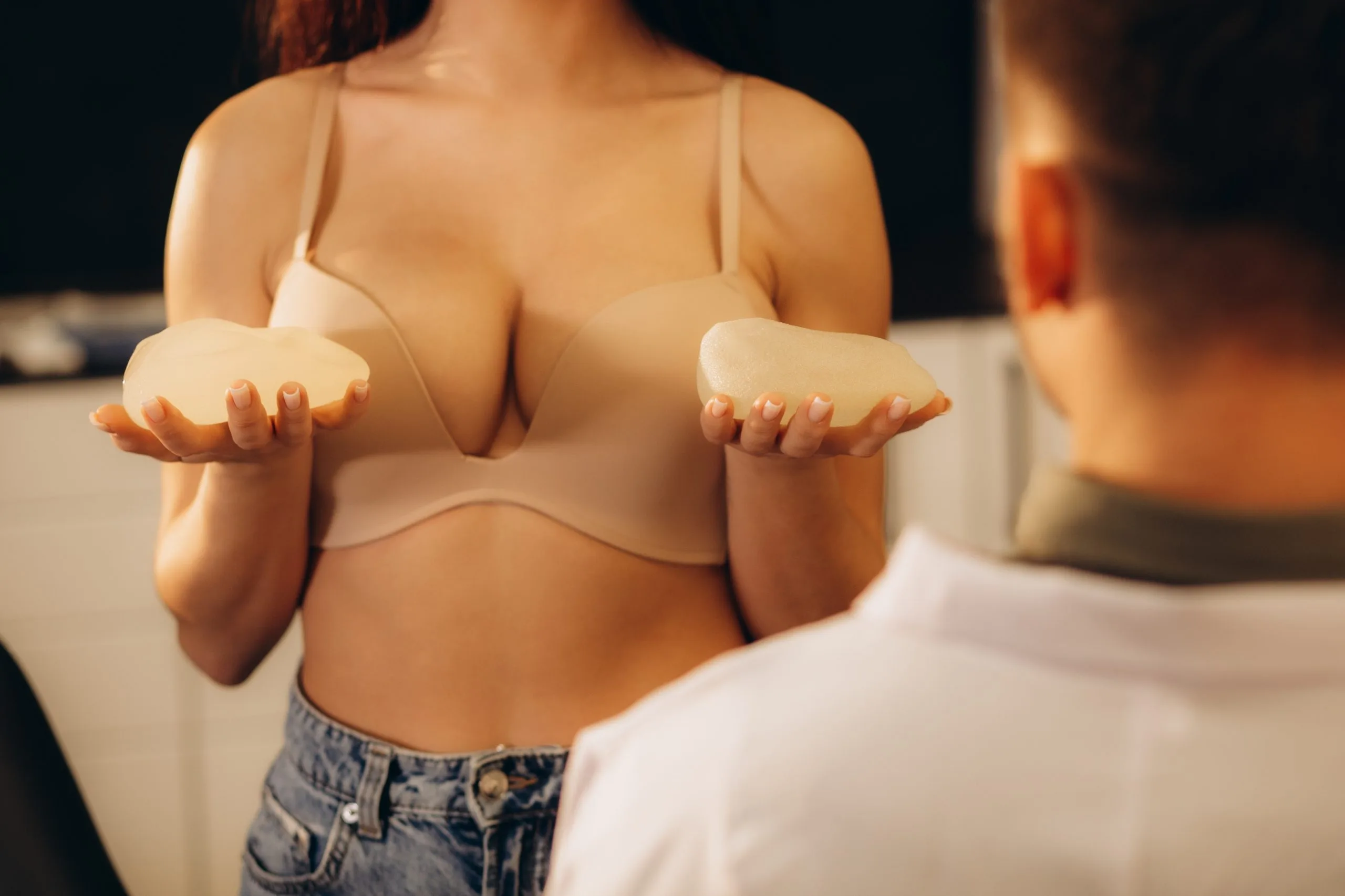
You should consider combining a breast lift with implants when you want a higher, firmer breast position and added volume in one operation. A lift raises and reshapes tissue that has dropped, while implants restore fullness that a lift alone cannot create. Together, they address sagging and volume loss, which are common concerns after pregnancy, weight changes, or aging. This combined procedure, known as an augmentation mastopexy, lifts the breast and enhances volume for a fuller, higher, more youthful contour.
A lift and implants are not interchangeable. Each one solves a different problem. Knowing what each procedure does – and what it cannot do – makes it easier to decide whether combining them is the right plan.
Breast augmentation uses implants to increase size, improve upper-pole fullness, and refine overall shape. Women often choose it when the breasts feel deflated after breastfeeding or weight loss, or when they want more volume than their natural tissue provides.
Saline or silicone implants are placed behind the breast tissue or under the chest muscle
Implants add projection, fill, cleavage, and a more balanced silhouette
They do not raise a nipple that has dropped below the crease or remove loose skin
If sagging is the main issue, implants alone can leave the breast looking full but still low – and can make droop more pronounced
A breast lift (mastopexy) addresses ptosis, the medical term for sagging breasts. The surgeon removes excess skin, tightens surrounding tissue, and repositions the nipple and areola higher on the chest.
It can also reduce a stretched areola
The goal is a firmer, perkier contour using your own tissue
A lift does not add lasting volume
Some women notice that their breasts look slightly smaller or “deflated” after extra skin is removed
If you want to stay the same cup size or go larger, a lift by itself will not get you there
Augmentation changes size and fullness
A lift changes position and tightness
Patients considering the implant side of this combination may also want to ask about Preservé®, a minimally invasive augmentation technique that emphasizes tissue preservation over disruption.
Implants are placed above the muscle rather than through it, which avoids cutting the pectoralis and can mean less post-operative tightness and a faster return to normal activity
The technique uses smaller incisions and precision instruments designed to minimize trauma to surrounding tissue
It’s generally suited to patients seeking a more subtle-to-moderate increase in fullness with a soft, natural feel, rather than a dramatic change in size
Preservé® can be performed alongside a breast lift in the same operation, so patients dealing with both sagging and volume loss don’t have to choose between a tissue-preserving approach and addressing ptosis
As with any technique, candidacy depends on individual anatomy and goals, and a consultation is the only way to know whether Preservé® or a more traditional augmentation approach is the better fit within a combined lift-and-implant plan.
This plan is often a fit if you:
Have ptosis – breasts that droop, with nipples that point downward or sit at or below the breast crease
Lost youthful fullness, especially in the upper pole, after pregnancy, breastfeeding, weight fluctuations, or aging
Want to be larger, or at least as full as you were before, once the breast is lifted
Notice one breast sits lower or looks smaller than the other
Women between 18 and 60 who are exploring breast or body cosmetic surgery are common candidates. However, age alone does not decide the plan. Skin quality, how much the breast has dropped, and the size you want matter more.
Restore a youthful profile. Reclaim the perky, full look from before children or weight changes
Deflation plus droop. The skin is loose, and the mound is empty. A lift tightens. An implant fills
A lift would make you smaller than you want. Removing skin can reduce cup size. An implant offsets that
You want upper-pole roundness. A lift raises the breast. An implant creates the slope or fullness at the top
Improve clothing fit. Feel more confident in swimwear, form-fitting tops, and bras
Correct asymmetry. One side may need more lift, a different implant volume, or both
One recovery, not two. Staging a lift and then implants later means two operations and two healing periods
If your only goal is a modest size increase and your nipples already sit in a good position, implants alone may be enough. If you like your current size but hate the sag, a lift alone may be enough. Combining the two is for the overlap – when both issues are present.
Pairing these two procedures offers several distinct advantages over staging them separately or choosing only one.
A lift without an implant can look lifted but flat. An implant without a lift can look full but low. Together, the breast sits higher and has the size and projection you asked for.
The lift tightens the skin envelope and repositions the nipple
The implant fills the new, uplifted shape and restores upper-pole fullness
Neither procedure can create that pairing on its own when both problems exist
Few people start with perfectly even breasts. Pregnancy, nursing, and natural development can leave one side lower, smaller, or both.
The lift can correct asymmetries in nipple height and breast shape
Implant sizes can even out volume
Raising the mound and filling it in the same operation keeps size and position aligned
The result is a naturally positioned, well-proportioned chest that complements your frame
For patients with poor skin elasticity, placing an implant without a lift can accelerate sagging as the skin struggles to support the new weight. By removing excess skin and tightening internal structures, the lift creates a stronger, more supportive pocket for the implant.
Adding an implant that matches your tissue helps the breast hold a fuller contour as swelling fades
This is not a promise that breasts never change
Weight shifts, future pregnancy, and aging still affect the result
The starting point – a lifted, filled breast – is more complete than either procedure alone
Two separate surgeries mean two rounds of time off work, two stretches in a surgical bra, and two periods of limited lifting. A combined operation is still surgery, and you still need to heal. You only go through that process once.
One course of anesthesia and one consolidated healing process
Specialized Plastic Surgery uses an ERAS protocol (Enhanced Recovery After Surgery) with nerve blocks
That protocol is designed to manage discomfort, support comfort after surgery, and streamline recovery so you can focus on one healing timeline
Ultimately, the decision is personal and depends on your body and your goals. If you look in the mirror and wish for breasts that are both higher on your chest and fuller in shape, this combination procedure may be the perfect solution.
At Specialized Plastic Surgery, our team will listen to your concerns, review your goals, examine breast position and volume, and explain whether a lift, implants, or both will get you closer to the result you want. Consultations are free.
Come prepared to talk about:
How your breasts have changed after pregnancy, weight loss, or aging
Whether size, droop, or both bother you most
The look you want in a bra and out of one
Any prior breast surgery, including implants you already have
If you already have implants and are dealing with sagging or an older result, revision surgery may be part of the conversation instead of a first-time augmentation. The consult can also confirm that you do not need both. A clear no is as useful as a yes.
A breast lift raises and tightens. Implants restore volume and upper fullness. When you have both sagging and deflation, combining them in one operation creates a higher, fuller shape and a single recovery. If you feel that your breasts have lost their youthful perkiness and fullness, a complimentary consultation at Specialized Plastic Surgery in Harrison, NY, or Millburn, NJ, can help determine whether an augmentation mastopexy is the right next step toward restoring your shape and confidence.

About the Author
Dr. Devulapalli
August 27, 2026